
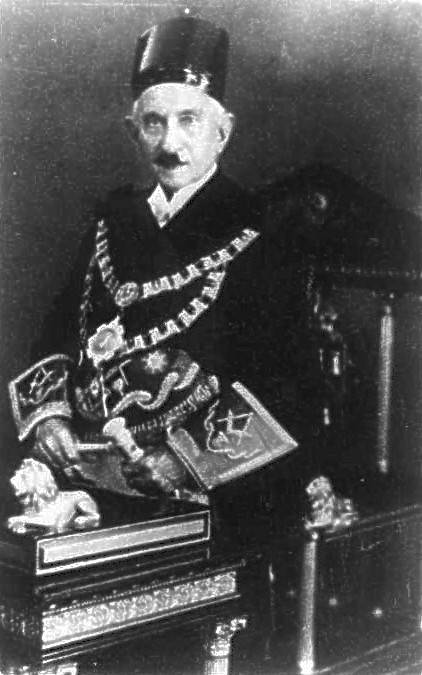
In 1932 the Grand Lodge of All Scottish Freemasonry in India installed its first Indian Grand Master. He was Dr Sir Temulji Nariman, a Parsi physician of Bombay. He was eighty-five years old.
He did not treat it as a decoration. He served out his term, continued past it and was still in office in 1938 when he died. Six years of active work, begun at an age when most men have handed everything over.
He once said that Freemasonry was very like the oath Hippocrates required of those entering medicine. Coming from a doctor of that generation, that is not a compliment lightly given. He meant that both were undertakings you made about your own conduct, before witnesses, with no external enforcement beyond your own word.
The arithmetic nobody likes
Here is the part of the story that Masonic writing tends to skip past.
Lodge Rising Star of Western India was founded in 1843 so that Indians could be Freemasons. In 1887, forty-four years later, K. R. Cama became the first Indian installed as Grand Master Depute, which is the second chair. It then took a further forty-five years before an Indian occupied the first.
Eighty-nine years from the founding of a lodge for Indians to an Indian at the head of Scottish Freemasonry in India. In a country where the overwhelming majority of the population was Indian. In a jurisdiction that by 1924 ran to seventy-four lodges spread from Bombay to Iraq.
And when it finally happened, the man chosen was eighty-five.
I do not think that detail is incidental. It is very hard to read the appointment of an eighty-five year old as a bold act of renewal. It reads more like a body honouring a man who had already given his life to it, at a point where the honour could be safely given.
Two ways to hold this
You can tell this as a story of progress. It is one. Cama in 1887, Nariman in 1932, then after Independence a District led by Indians as a matter of course. Each step was real and somebody had to make it.
You can also tell it as a story of how slowly institutions move even when their stated principles point the other way. Freemasonry taught, in that same room, in that same century, that a man is to be judged by his character. It took eighty-nine years for its own arrangements in India to catch up with what it was saying out loud every month.
Both are true. I would rather our website carried both than the flattering half.
What was left behind
Neither man is a name on a plaque only.
K. R. Cama died in 1909. A marble tablet to his memory was unveiled in Freemasons’ Hall in Bombay in 1911. In 1930 a lodge was founded in his name, K. R. Cama No. 1366, which still works.
Sir Temulji Nariman has a lodge too, No. 1516, founded in his memory in 1958. It was the last lodge consecrated in the District.
There is something fitting about a man installed at eighty-five being remembered by the youngest lodge on the roll.
Why I find him useful
I am the Secretary of a lodge and I spend a certain amount of time worrying about who will do the work next.
Nariman is a corrective to the assumption that the work belongs to the middle-aged. He took the heaviest office in Indian Scottish Freemasonry at an age when nobody would have thought less of him for declining. He was still doing it six years later. Somewhere in every lodge is a brother who has quietly decided that his useful years are behind him. He is probably wrong.
Historical detail draws on the History of Scottish Freemasonry in India prepared by Bro. Bomi S. Mehta, Rt. Wor. District Grand Master of the District Grand Lodge of India 1997 to 2007, published on the website of the District Grand Lodge of India (Scottish Constitution).