
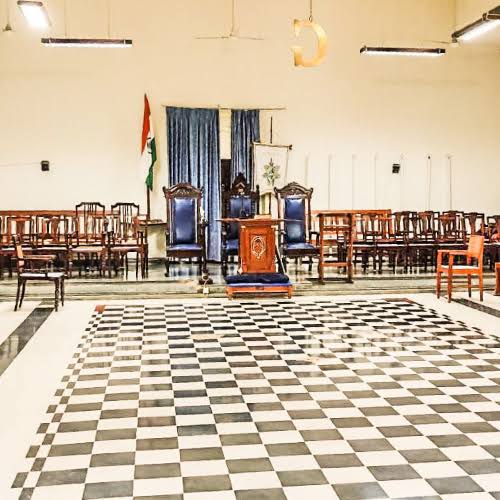
Bring somebody into a Masonic temple for the first time and they will look at three things. The chairs, the ceiling, then the floor. The floor is the one they ask about.
Ours is black and white squares, laid in a long rectangle down the centre of the room, finished with a dark border band and polished to the point where the tube lights above it come back at you in the surface. It is the first thing your eye follows when you come in, because it runs away from you towards the east end of the room and pulls your attention with it.
It is called the mosaic pavement. Almost every lodge in the world has one, in stone or tile or painted canvas. Nobody has ever needed to explain to me why it is there, which is exactly why I want to write it down.
What it means
The explanation is old and it is public. It has been printed in Masonic books for well over two hundred years, so there is nothing improper in setting it out here.
The chequered floor stands for the mixed nature of human life. Light and dark, laid side by side, in equal measure, repeating without end. Good fortune and bad. Health and illness. The good year and the year you would rather not remember. The point is not that life contains both, which everybody knows. The point is that they are laid out in the same pattern, in the same floor. You walk on all of it.
That is a plainer and harder idea than it first sounds. It does not promise that the dark squares are a passage to somewhere better. It does not say they are deserved. It says only that they are part of the floor, that the pattern continues and that a man is expected to keep walking across it with the same bearing whether he happens to be standing on a white square or a black one.
Why a floor and not a picture
I have come to think the choice of a floor rather than a wall hanging is the whole of it.
You do not contemplate a floor. You stand on it. You cross it to get from one part of the room to another. You do it every time you attend and after a few years you stop noticing you are doing it at all.
That is a fair description of how a set of principles actually gets into a man. Not by being admired. By being walked over so often that it becomes the ordinary ground under him.
The border
There is a border running round ours, as there is round most.
The old explanations connect it to the idea of a boundary drawn around the whole. Different writers have taken it different ways over the centuries. I will not pretend to more certainty than I have. What I notice, sitting in the room, is simpler. The border is where the pattern stops. The floor is not infinite. It has an edge. Beyond the edge is the rest of the building and then the street and then Bengaluru on a Tuesday evening.
A room that teaches you about the mixed nature of life also quietly reminds you, in its own flooring, that the room ends.
If you visit
Look at it properly before the lodge opens. Stand at the western end and look east along it. It is a good floor, kept well by generations of brethren who mostly did not write anything down about it.
Then, when somebody asks you what the chequered floor means, you will be able to tell them, because it was never a secret.